MAE is your company's private AI. It turns the commitments people make in meetings into tracked work with an owner and a date, checks in on that work where your team already is, and tells a manager what actually moved. It runs Comserv Connect's own five-person team every day.

If you would rather watch than read, start here. Everything below is the same story with the detail put back in.
Follow a single sentence from a meeting all the way to a closed task. The left column is what a person says or does. The right column is MAE, which nobody had to open, launch, or remember.
This replay is a written walkthrough of the daily loop, not a recording of a real meeting. We will show you MAE running on our own live data during the screen share.
A person approves the task and a person does the work. Everything between those two is MAE, and none of it needs anyone to open an app.
Nobody presses a button and nobody writes up notes. The transcript comes in on its own, and MAE reads it the way a very attentive assistant would have: looking for the sentences where somebody committed to something.
A commitment becomes a task with an owner and a date. Not a summary, not a bullet list nobody reads: a piece of work with a name on it. Each one keeps the sentence that created it, so when somebody says "I never agreed to that," you can both read what was actually said.
Extraction is a suggestion, not a decree. The owner sees a card and confirms, corrects, or throws it away in one tap, without leaving Slack. This is the gate that keeps the board honest, and it is deliberately the lowest-effort thing on the page.
One message per person at the start of the day: what is due today, what slipped, and what is waiting on somebody else. It is short on purpose. A brief nobody reads is worse than no brief at all.
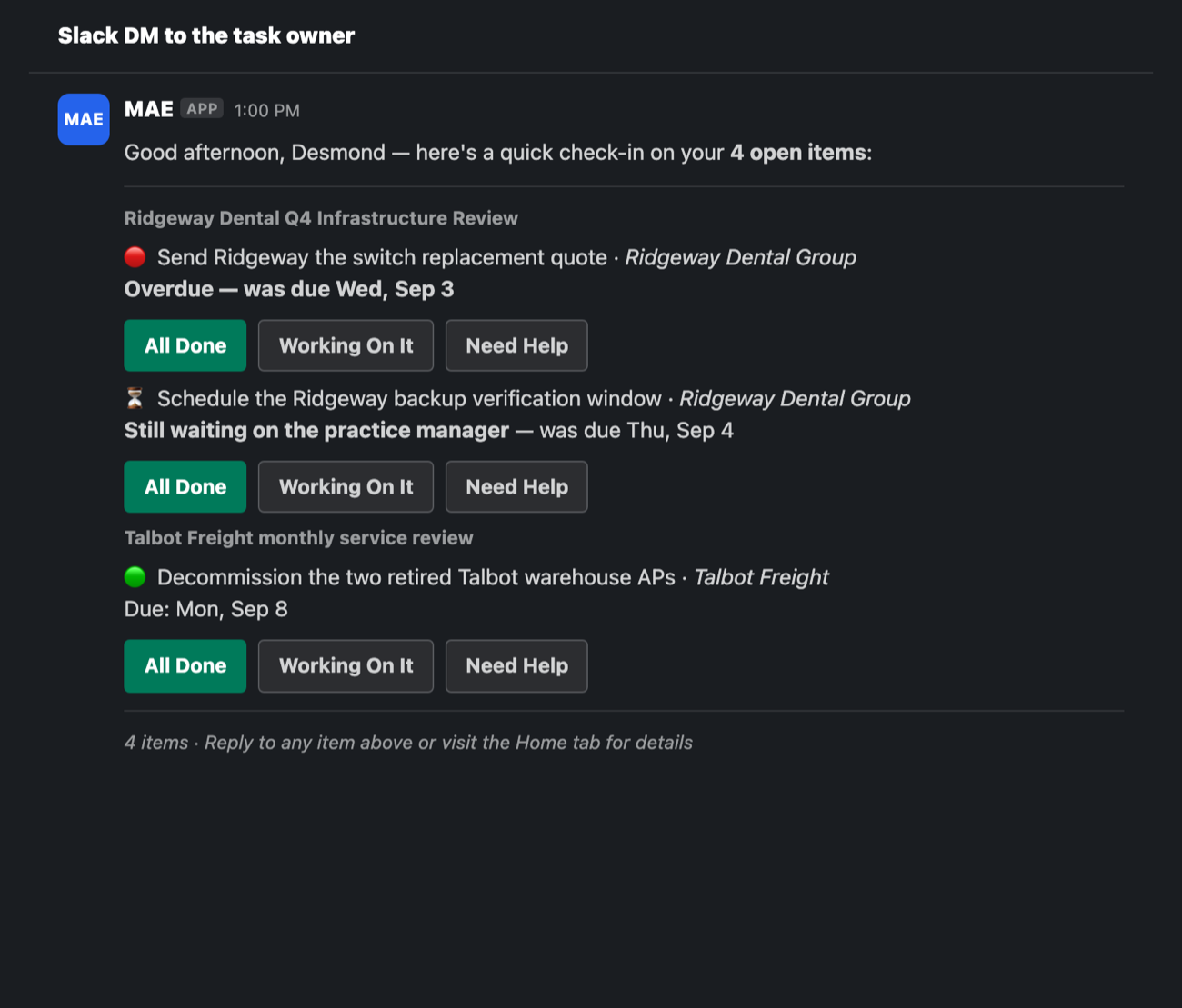
When a due date passes with no update, MAE asks, in a threaded direct message rather than a fresh ping. It asks once, politely, and it asks the person who owns the work rather than escalating straight to their manager.
This is the part that surprised us most in our own shop. A one-word "done" does not close anything on its own. MAE reads the reply against what was actually promised, and an answer that does not answer gets asked again. Follow-through that only looks like follow-through stops counting.
For teams running a service desk, the same discipline applies to tickets: the ones sitting too long, the ones bouncing between people, the ones where the customer has been waiting on you and not the other way around. Judged against your thresholds, not a vendor's defaults.
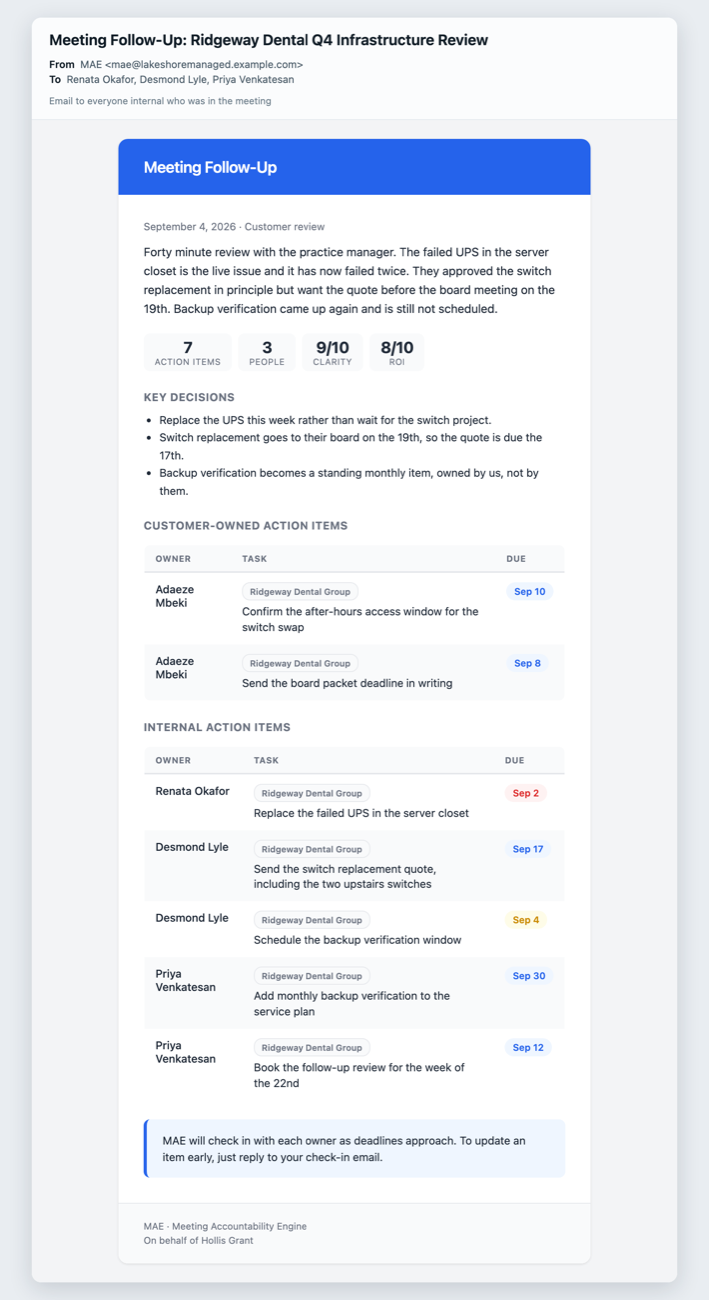
At the end of the day, one email: what moved, what did not, and who is waiting on whom. A manager can act straight from it, and it is the same picture everybody else already saw in their own brief. No separate reporting exercise.
Software your team has to remember to open is software your team stops using. MAE lands where they already are, and the web app is for when you want to dig in rather than for daily use.
What happens when a commitment goes quiet. Two rungs on this ladder are marked "coming" because they are not built yet, and we would rather show you the roadmap than let you assume.
Almost nobody on our team opens the MAE web app on a normal day. This is what they see instead. These are the real renders, filled with an invented client so we are not showing you ours.
MAE runs on your own context: your meetings, your documents, your SOPs, your tickets. Your data stays in your environment and is not used to train a public model. If your tool is not on this list, ask us: the pattern is the same wherever there is an API.
Ten-seat minimum. Included in Comserv managed-service plans, so if we already run your IT, you already have it.
The minimum is not a sales tactic. MAE works by seeing what a whole team commits to, and a two-person deployment does not have enough of a loop to be worth anyone's money.
Call the demo line to hear what our voice agents sound like. Book fifteen minutes to watch MAE run on real data.