QualiConnect · email and text

Renewals thatchase themselves.

QualiConnect runs your renewal and donor program end to end: the invoice goes out, the reminders climb on a schedule, the payment is recorded in seconds, and anyone who has already paid stops being chased. On September 1, 2026, one renewal send delivered 100 of 100 emails, and the first payment came back the same afternoon.

Seventy-five seconds,
if that is all you have.

If you would rather watch than read, start here. Everything below is the same story with the detail put back in.

Explainer video slot assets/demo/qualiconnect/explainer-75s.mp4
A 75-second narrated explainer of a full renewal cycle. In production with our content desk, from the storyboard the product team is writing.

The member on the left.
The program on the right.

A renewal cycle is months long, so here it is compressed. The left column is what a member actually experiences. The right column is the program running underneath: the send, the delivery check, the reply routing, the payment, the board.

Harborview Community Alliance is a made-up organization, and so is every person, amount and address in it. We invent the members so we are not showing you a real client's roster. The timings, the tag writes and the board moves are the real ones: the stamps run from three weeks before the renewal date to six weeks after it.

Five stages.
You touch two of them.

You approve the list and you answer the replies that need a person. The rest runs whether or not anyone opens a laptop.

Stage one
The cycle opens
Every member lands on the board in the column that says where they really are. You review the list before a single email moves.
Stage two
Invoice and send
The invoice is generated, attached to the member record, and sent. Delivery is confirmed per contact rather than assumed, so a bounce is a fact you know, not one you find out about in November.
Stage three
The ladder climbs
Reminders go out on the schedule below. Anyone who has paid, or who is mid-conversation with your staff, drops out of it automatically.
Stage four
Payment recorded in seconds
The payment processor tells us the moment money lands. The record updates, the card moves itself, and the remaining reminders are suppressed. Nobody retypes anything.
Stage five
Monday summary
One email: who paid, who is owing, who replied and is waiting on you, and who has gone quiet. Read it with your coffee and you are current.

The invoice, the payment,
the board, the quiet donor.

1
The invoice and payment path

Each member gets their own invoice, attached to their own record, with a payment link that works on a phone. If they say they cannot find it, your staff resends it in one action from the same record, and the resend is logged there too.

Somebody paying by check is not a broken case. You mark it, and the same suppression rules apply.

2
The payment is recorded in seconds

When money lands, the payment processor tells the program immediately. It is not a nightly import and it is not somebody reconciling a spreadsheet on Friday. The member's record shows paid, the board card moves itself, and the reminder ladder stops for that member.

The failure mode we care most about is chasing somebody who already paid. That is the one that costs you a relationship, so the routing fails closed: when the program is not sure a payment belongs to a renewal, it asks rather than assuming.

3
The board view

One board, one card per member organization, in the column that says where they stand: not renewed, invoiced, in conversation, renewed. Your staff work the board the way they already work a board. Dragging a card to Renewed is a real action that updates the record behind it.

4
The donor who went quiet

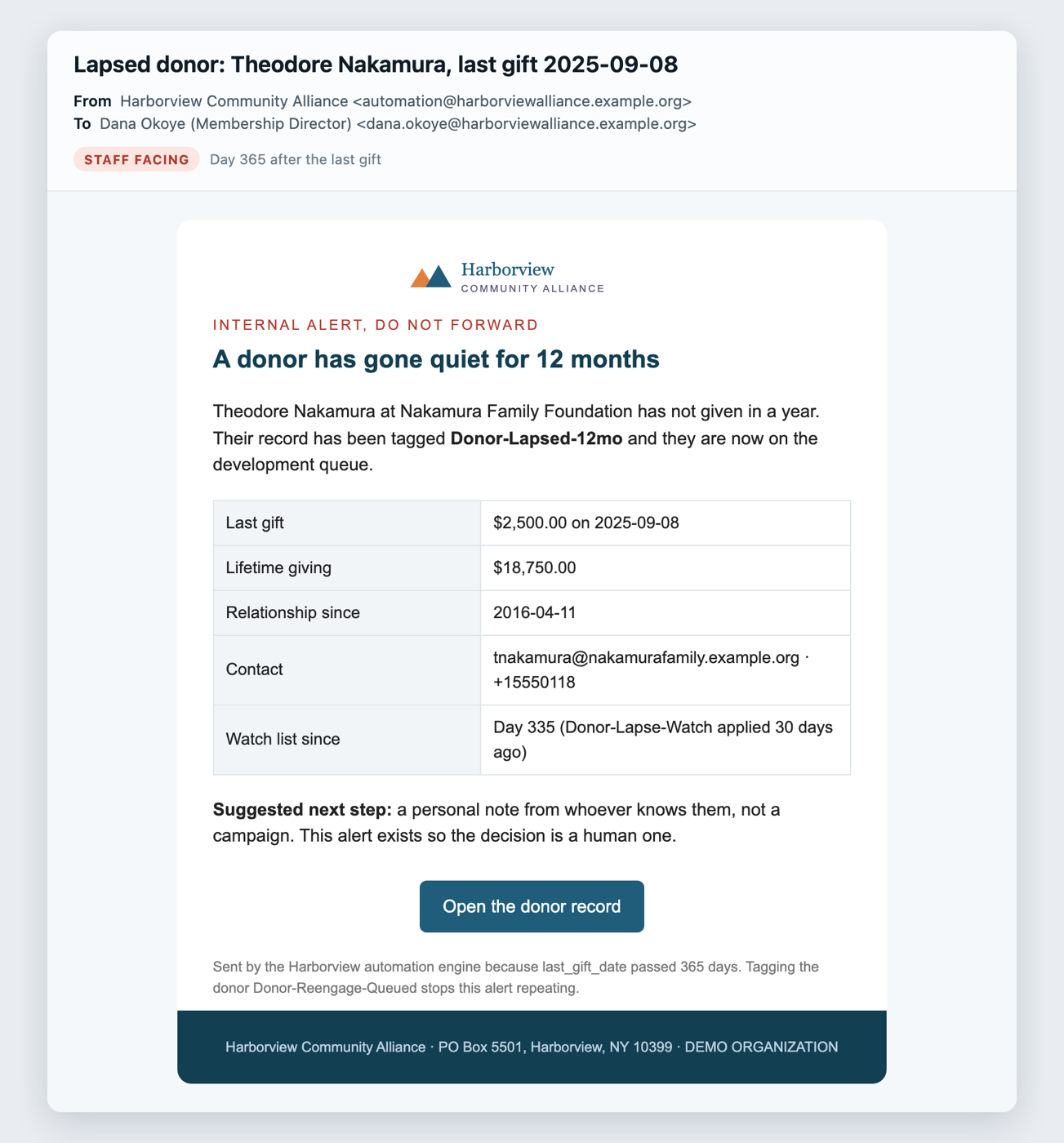
The expensive misses are not the people who say no. They are the ones who simply stop: no gift, no reply, no complaint, for a cycle and then two. Those are surfaced by name rather than left for you to notice, because the whole point of a program is that nobody has to remember.

5
The Monday summary

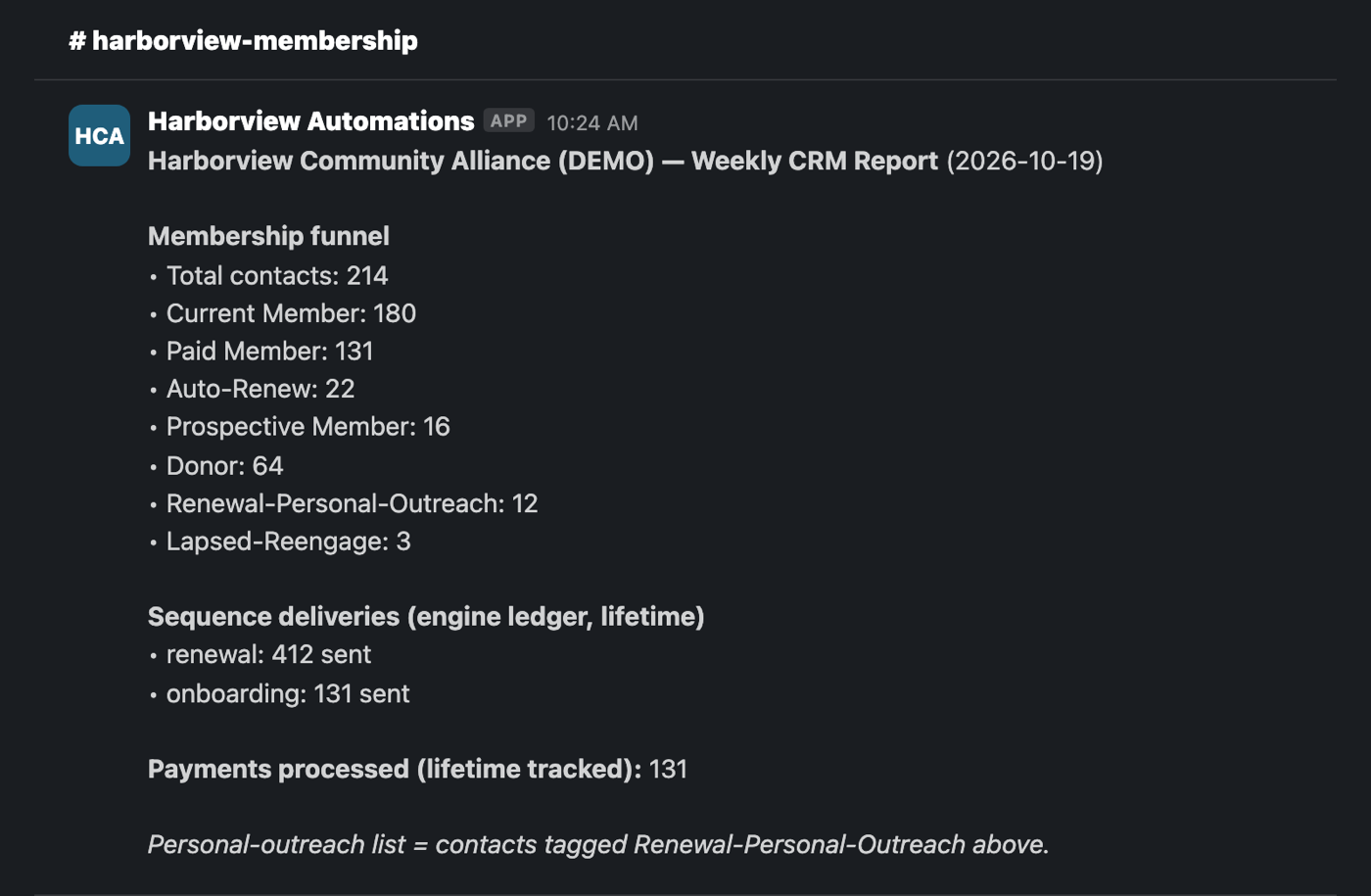
One email at the start of the week that a director can read in ninety seconds and a board member can be forwarded without editing. Who paid, who is owing, what came back that needs a person, and what changed since last Monday.

Persistent without
being a nuisance.

Each rung fires only if the one before it did not land the payment. Every timing here is a number you set. The moment somebody pays, or replies to a human, the whole ladder stops for them.

In their inbox,
and in yours.

Your members see email. Your staff see alerts and one summary. These are the real renders, filled with an invented organization.

Member email
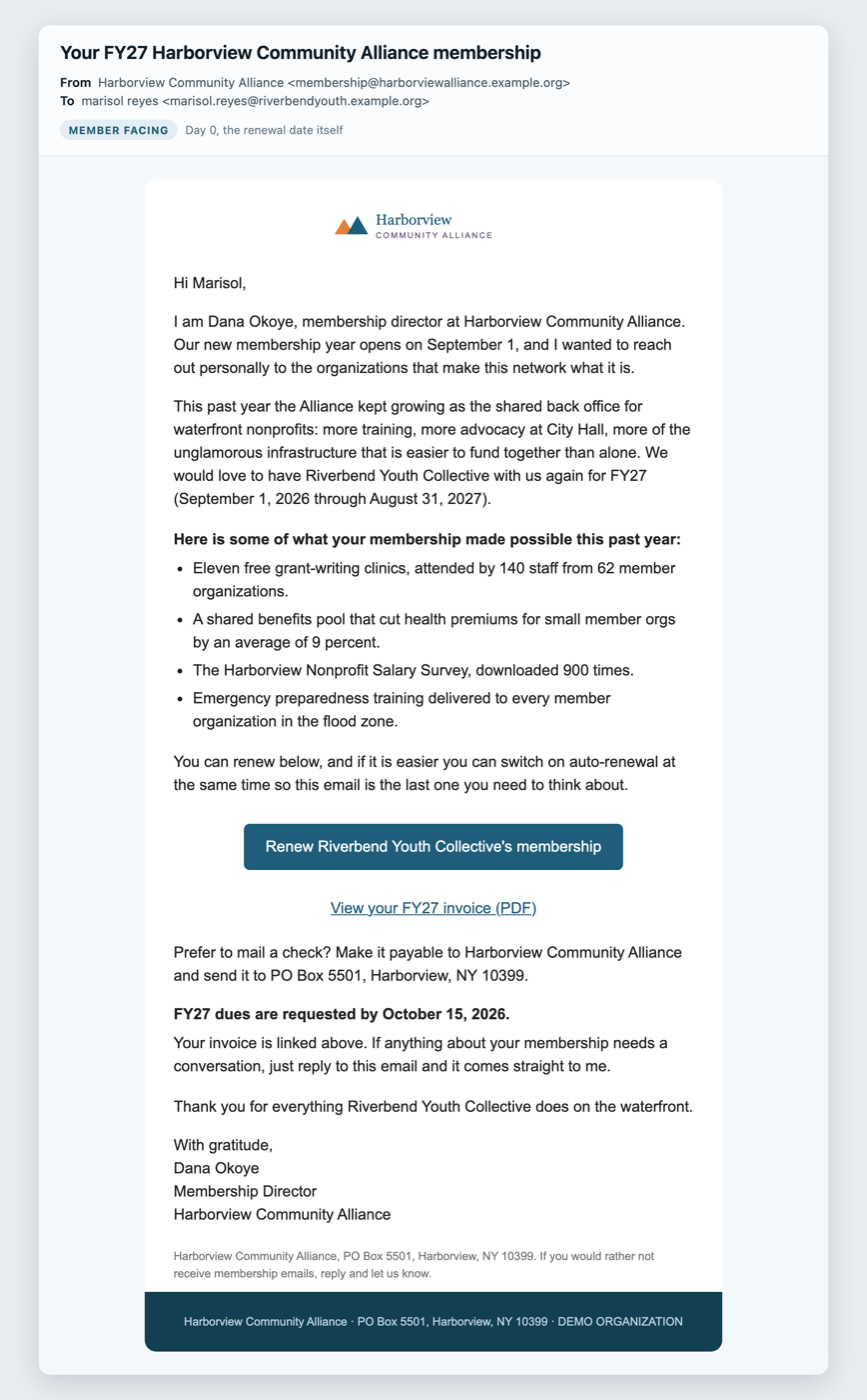
The renewal notice: their name, their organization, what the year bought them, and a renew button that works on a phone.
Staff alert, coming
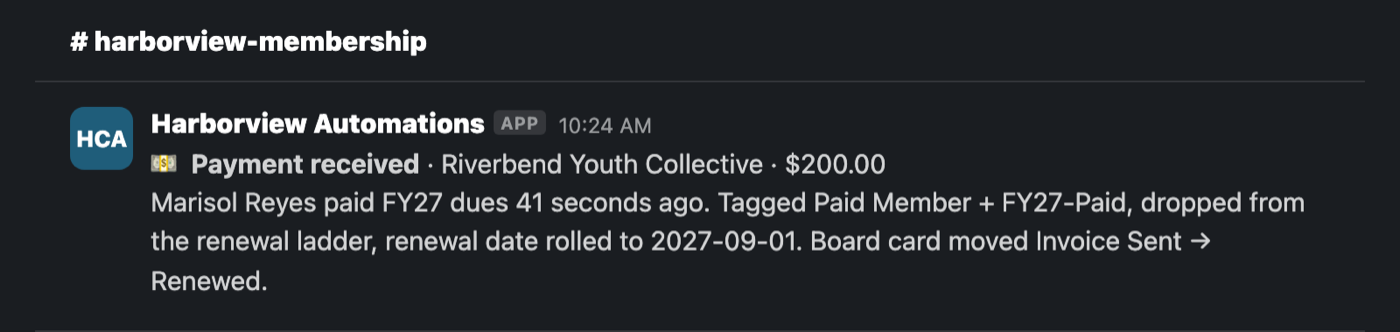
A payment landing: who paid, how much, and the card that moved itself as a result. The payment, the tags and the card are live today. This alert is the next piece.
Staff alert
The donor who went quiet, surfaced by name rather than left for somebody to notice.
Monday summary
The Monday summary: who paid, who is owing, what came back that needs a person.

Where your staff
actually work.

Product screenshot pending assets/demo/qualiconnect/01-board-view.png
The board: every member organization as a card, in the column that says where they stand.
Product screenshot pending assets/demo/qualiconnect/02-member-record.png
One member: the invoice, every email sent, every reply, and the payment against it.
Product screenshot pending assets/demo/qualiconnect/03-payment-recorded.png
A payment landing: the card moves itself and the remaining reminders are suppressed.
Product screenshot pending assets/demo/qualiconnect/04-monday-summary.png
The Monday summary: who paid, who is owing, who has gone quiet.

Your CRM stays
the record.

QualiConnect runs on top of the systems you already have rather than replacing them. If yours is not on this list, ask us: the pattern is the same wherever there is an API.

GoHighLevel Postmark Zeffy Microsoft 365 and Teams Slack Google Workspace and anything with an API

A managed program,
not a seat license.

From $1,500 a month

Managed renewal program from $1,500 a month plus $2,975 setup. We build the program, run the sends, and stay on it. You are not being handed a tool and wished well.

For federally funded organizations: cybersecurity and data systems can be direct costs on federal awards under 2 CFR 200.413(b). Ask us for the allowable-cost memo and give it to your finance team.

Fifteen minutes.
Nothing to install.

Michael or Chris runs it
A person from our team, not a call center and not a sales development rep reading from a script.
Screen shared, phone or computer
Nothing to install and nothing to connect. You watch our screen. Fifteen minutes, and we hold to it.
Your scenario, not ours
Bring your renewal list, your cycle dates, and the members you dread chasing. We run it against the real thing.

Hear it, then
see it.

Call the demo line to hear what our voice agents sound like. Book fifteen minutes to see your own renewal cycle mapped out.

Demo line: +1 (929) 593-4959. It is a demo, so nothing you say reaches a real member.